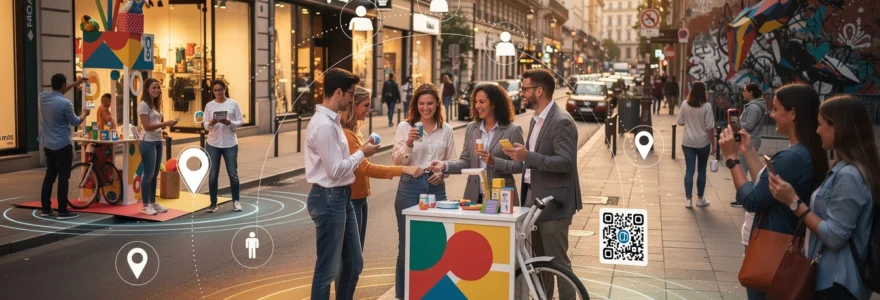
In an increasingly digital world where algorithms dictate audience reach and screen fatigue dampens engagement, street marketing continues to deliver tangible results for businesses seeking authentic local connections. While social media campaigns offer scale and data analytics provide precision, physical brand activations create memorable experiences that digital channels simply cannot replicate. The tactile nature of handing someone a sample, the surprise of encountering an unexpected installation, or the communal energy of a pop-up event generates emotional responses that translate directly into brand loyalty and purchasing decisions. For local businesses competing against national chains and e-commerce giants, street marketing offers a powerful equalizer—the ability to dominate a specific geographic area through consistent, high-impact presence that competitors cannot easily disrupt.
Recent market research indicates that 68% of consumers form their opinion about a brand based on physical interactions, whilst 72% of consumers say that engaging with branded event marketing experiences makes them more likely to purchase the products being promoted. These figures underscore a fundamental truth about human psychology: we are sensory creatures who trust what we can see, touch, and experience directly. Street marketing capitalises on this biological reality, creating brand encounters that bypass the cognitive filters we’ve developed to ignore digital advertising. When executed strategically, street-level activations generate compound returns—immediate sales from direct interactions, word-of-mouth amplification through memorable experiences, and social media virality when campaigns incorporate shareable elements.
Neurological impact of physical brand interactions on consumer memory retention
The human brain processes physical experiences fundamentally differently than digital content. Neuroscience research reveals that tangible brand interactions create stronger neural pathways and more durable memory formation than passive viewing of advertisements. When you participate in a street marketing activation—whether picking up a product sample, touching branded materials, or engaging in an experiential activity—your brain encodes the experience through multiple sensory channels simultaneously. This multi-modal encoding creates what cognitive psychologists call « elaborative rehearsal, » a process where information gets transferred from short-term working memory into long-term storage with significantly higher retention rates. Studies using functional MRI technology demonstrate that physical brand interactions activate the hippocampus and prefrontal cortex more intensely than digital exposures, regions critical for memory consolidation and decision-making.
Haptic marketing triggers and limbic system activation patterns
Haptic marketing—the strategic use of touch in promotional activities—exploits a direct neural pathway to emotional response centres. When you physically handle a product sample or branded promotional item during a street marketing encounter, mechanoreceptors in your skin transmit signals through the somatosensory cortex directly to the limbic system, particularly the amygdala and nucleus accumbens. These brain structures govern emotional processing and reward anticipation, creating positive associations with the brand before conscious evaluation occurs. Research published in the Journal of Consumer Psychology found that participants who physically handled products during marketing encounters demonstrated 40% higher purchase intent compared to those who only viewed identical products visually.
The texture, weight, and temperature of promotional materials all contribute to these neurological responses. A premium business card with raised lettering creates different neural activation patterns than a standard printed flyer. Street marketing campaigns that incorporate tactile elements—from textured packaging samples to interactive installation components—leverage these haptic triggers to establish deeper brand connections. This explains why product sampling remains one of the highest-converting marketing tactics, with conversion rates averaging 35-40% compared to 2-3% for traditional digital advertising.
Multi-sensory engagement through tangible promotional materials
Beyond touch, street marketing activations that engage multiple senses simultaneously create what neuroscientists term « cross-modal integration »—the brain’s synthesis of information from different sensory channels into unified, robust memories. A food brand sampling campaign that combines visual appeal (attractive presentation), olfactory stimulation (product aroma), gustatory experience (taste), and tactile interaction (packaging texture) creates neurological reinforcement across four distinct sensory pathways. Each additional sense engaged in a marketing encounter increases memory retention by approximately 15-20%, according to sensory marketing research.
Consider how a coffee brand’s street marketing activation might incorporate the visual appeal of professional baristas in branded attire, the aromatic intensity of freshly ground beans, the auditory signature of espresso extraction, the tactile warmth of a cup in hand, and the gustatory pleasure of the product itself. This sensory orchestration creates a comprehensive neural signature that remains
far more distinctive than yet another banner ad in a crowded social feed. In practical terms, this means that a single, well-designed street marketing activation can create a « mental bookmark » in your audience’s mind, making your local business the first brand they recall when a purchase need arises days or even weeks later. For local visibility, this deep encoding is critical; you are not just generating impressions but building durable memory traces that continue to influence behaviour long after the event has ended. By designing your street campaigns around multi-sensory engagement, you dramatically increase the chances that consumers will both remember and act on your message.
Brand recall metrics: street sampling vs digital display advertising
When we compare street marketing to digital display advertising on pure recall metrics, the difference is striking. Studies from experiential agencies consistently show unaided brand recall rates of 60–80% following in-person sampling, versus 10–20% for standard display ads seen on mobile or desktop. Part of this gap comes from the « banner blindness » effect—users have trained themselves to ignore most on-screen advertising, whereas a real person handing you a sample in a public space is almost impossible to overlook. In local marketing campaigns, this heightened recall translates into more store visits, more direct enquiries, and stronger word-of-mouth within the neighbourhood.
Street sampling also benefits from contextual relevance in a way that most digital ads cannot match. When you taste an energy drink while commuting or try a snack outside a supermarket, the experience is anchored to a real-life use case, which strengthens both recall and purchase intent. Digital display advertising often interrupts whatever the user is doing, whereas street activations integrate into their existing behaviour. For local businesses looking to improve local search visibility and brand recognition, combining physical sampling with follow-up digital touchpoints—such as retargeting ads or geofenced push notifications—creates a powerful, cross-channel memory loop.
Elaboration likelihood model applications in face-to-face marketing encounters
The Elaboration Likelihood Model (ELM) helps explain why street marketing encounters are so persuasive. According to ELM, people process messages either through a central route (careful consideration of information) or a peripheral route (quick judgments based on cues like likeability or visuals). Face-to-face street interactions can activate both routes simultaneously. When a brand ambassador answers detailed questions or demonstrates a product, they engage the central route; when they smile, wear appealing uniforms, and create a fun atmosphere, they stimulate the peripheral route. This dual processing increases the chances that the message will stick and influence behaviour.
For local visibility, this means your street team can tailor the depth of information to each passer-by’s level of interest. Someone in a hurry might respond primarily to the peripheral cues—a free sample, a short message, a QR code—while a more engaged prospect might stay for a deeper conversation about features, pricing, or subscription options. By designing scripts and training materials around ELM principles, you ensure that every interaction, from a two-second handoff to a five-minute chat, has the potential to move people closer to a conversion. Think of it like a live version of a well-structured landing page: you have multiple paths to persuade, depending on the user’s intent.
Hyperlocal targeting precision through geographic guerrilla tactics
One of street marketing’s greatest strengths is its ability to target audiences at a hyperlocal level with remarkable precision. Unlike broad digital campaigns that may waste impressions on users outside your service area, geographic guerrilla tactics allow you to concentrate effort exactly where your best customers live, work, and travel. By mapping local foot traffic, analysing neighbourhood demographics, and observing daily patterns, you can position your brand where the probability of high-intent encounters is highest. This is particularly powerful for local SEO strategy, as repeated physical exposure in a specific area reinforces the digital signals you are sending through search and maps.
Hyperlocal targeting also supports a « surround sound » effect: residents see your street teams near transit stops, encounter your pop-ups at local markets, and later discover your listing when they search « best coffee shop near me » or « local gym open now. » The physical presence makes the digital result feel more credible and familiar, shortening the decision-making process. By thinking in terms of micro-areas rather than entire cities, you can deploy smaller, more agile campaigns that still create a sense of local dominance around your location.
Footfall analysis and high-traffic zone identification methodologies
Effective street marketing begins with understanding where people actually move throughout the day. Footfall analysis combines observation, local knowledge, and increasingly, data from mobile devices and city planning reports to identify high-traffic zones. You might look at commuter paths to train stations, entrances to shopping centres, school pick-up areas, or the busiest street corners near your store. Many local councils and commercial landlords publish anonymised traffic data, and location analytics tools can provide additional insight into dwell time and peak periods. By layering these data sources, you can pinpoint the top 5–10 micro-locations where your presence will generate maximum impressions per hour.
From a practical standpoint, running small tests at different times and locations helps validate your assumptions. You can rotate teams through various spots for short intervals, tracking how many leaflets are handed out, how many conversations are started, and how many QR codes are scanned. Over a few weeks, you build a picture of the true « hot zones » for your local market. This approach mirrors A/B testing in digital marketing but applies it to the physical world, letting you iterate quickly and allocate your street marketing budget to the most productive spaces.
Demographic profiling via neighbourhood characterisation frameworks
Not all high-traffic areas are equal; the value of an impression depends heavily on who is walking past. Neighbourhood characterisation frameworks—like local census data, commercial demographic segments, or even simple observation—help you align your street marketing with the right audience. For example, a premium fitness studio might prioritise streets near co-working spaces and high-income residential blocks, while a fast-casual restaurant might focus on university districts and office corridors. By combining demographic data with local SEO keyword research (« family-friendly restaurant in [district] » or « budget gym near [station] »), you ensure your offline and online targeting work hand in hand.
In practice, this can be as simple as creating persona-based maps: one for students, one for young professionals, one for families, and so on. You then plot where each persona spends time—parks, transit lines, nightlife areas, shopping streets—and design street activations that speak directly to their needs and language. Think of it as geotargeting without the screen: instead of relying on an algorithm to decide who sees your ad, you physically go to the places where your ideal customers already are. The result is fewer wasted interactions and higher conversion rates from each day of field activity.
Event-based ambush marketing during local festivals and markets
Local festivals, markets, and cultural events create natural gathering points for your target audience, making them prime opportunities for street marketing. While official sponsorship can be expensive, ambush marketing tactics—appearing near, but not inside, the event footprint—allow smaller brands to tap into the same crowds at a fraction of the cost. You might position a sampling stand near an entrance, deploy a roaming street team along the main route, or host a mini-activation in a nearby plaza. Because people are already in a discovery mindset, they are more open to trying new products and sharing experiences on social media.
The key is to remain respectful of event organisers and local regulations while still standing out. Creative props, portable signage, or small experiential elements (like a photo booth or quick game) can draw attention without requiring a huge build. For local visibility, aligning your brand message with the event’s theme—food at a street food festival, wellness at a marathon, creativity at an art fair—helps your presence feel relevant rather than intrusive. These moments also generate rich content for your local SEO strategy, as you can publish blog posts, photos, and short videos that tie your brand to beloved neighbourhood events.
Pop-up activation strategies near competitor retail locations
Another powerful geographic guerrilla tactic is to activate near competitor locations, especially those with strong existing foot traffic. By placing a pop-up stand, branded bike, or mobile cart close to a rival retailer, you intercept high-intent shoppers at the moment they are considering a purchase. This can be as subtle as offering complimentary samples with a clear value proposition— »same quality, better price, » or « local alternative to the big chain »—or as bold as running time-limited offers to encourage trial. The proximity creates an immediate comparison in the customer’s mind, giving your brand a chance to win attention without a large advertising budget.
Of course, this approach requires tact and a deep understanding of local regulations. You must ensure you are on public land or have permission from the property owner, and avoid obstructing entrances or creating conflict. Done well, competitor-adjacent pop-ups can become a recurring strategy, especially if you notice long queues or consistent overflow foot traffic at their location. Over time, some of those visitors will switch allegiance, drawn in by your friendly staff, unique offer, or simply the convenience of engaging with your brand while they wait.
Cost-per-impression advantages in pedestrian-dense urban environments
From a pure media efficiency standpoint, street marketing in dense urban areas can deliver a remarkably low cost per impression. A single branded installation or well-positioned team can generate thousands of daily exposures from passers-by, many of whom live or work within your immediate catchment area. When you spread the cost of permits, materials, and staff over the total number of impressions and interactions, the effective CPM (cost per thousand impressions) often outperforms digital channels—especially once you factor in higher engagement and recall rates. For local businesses with limited budgets, this means you can « own » a key corner or transit hub for days at a time without the ongoing bidding wars of paid search or social ads.
Moreover, street marketing impressions are not just counted; they are experienced. Unlike a fleeting, scroll-past moment on a phone, a physical presence occupies space and time, making your brand feel like part of the neighbourhood. This ambient visibility supports your local SEO efforts by building familiarity: when residents later see your listing in Google Maps, it is no longer an unknown name but « that coffee cart by the station » or « the team that handed out samples at the weekend. » In this way, street marketing acts as a force multiplier for all other channels, improving the effectiveness of both organic and paid digital campaigns.
Social media amplification through instagrammable street installations
While street marketing is inherently offline, its impact can be dramatically amplified through social media—especially when you design installations that are inherently « Instagrammable. » Eye-catching murals, playful sculptures, interactive walls, or clever optical illusions encourage passers-by to stop, take photos, and share them with friends. Every share extends your local reach beyond the immediate street, effectively turning your installation into a hybrid between outdoor media and user-generated content engine. For brands focused on local visibility, this combination is potent: you command attention on the pavement and in the feed.
The secret lies in thinking like both an urban designer and a content creator. Ask yourself: would you photograph this if you saw it on holiday? Would you show it to a friend? When your street marketing assets pass that test, they become organic content hubs that drive ongoing impressions long after your team has left for the day. This is particularly powerful for visual platforms such as Instagram and TikTok, where local hashtags and geotags help users discover nearby businesses through shareable moments.
User-generated content multiplication rates from experiential activations
Experiential activations that invite participation rather than passive observation generate much higher user-generated content (UGC) rates. When people can pose inside an installation, trigger a light or sound effect, play a quick game, or customise a product sample, they feel a sense of ownership over the moment. That emotional investment translates into a greater likelihood of taking photos, recording videos, and posting them online. Industry benchmarks suggest that well-designed experiential campaigns can achieve UGC rates of 10–20% of total participants, compared to low single digits for static billboards or generic booths.
This « multiplication effect » means that every in-person interaction has the potential to create dozens more impressions online. A single group of friends might tag multiple contacts, use your branded hashtag, and share across several platforms, each time extending your local reach. To maximise this effect, street marketers should remove friction: make it easy to capture good photos with clear backdrops, provide helpful prompts or photo ideas, and ensure your brand name or logo appears in-frame without being overwhelming. Think of your activation as a mini content studio on the street—one where your customers are both the stars and the distribution channel.
Hashtag campaign integration with physical brand touchpoints
Integrating hashtag campaigns with physical brand touchpoints turns your street marketing presence into a strategic bridge between offline and online visibility. By prominently featuring a short, memorable hashtag on your installations, uniforms, and printed materials, you give people a simple way to connect their posts back to your brand. When combined with local keywords or neighbourhood names (for example, #TasteDowntown[City]), these hashtags help group user-generated content around both your brand and your local area, reinforcing your positioning in the community.
To encourage adoption, many brands pair hashtags with small incentives: a weekly prize for the best photo, a discount for those who show their post in-store, or a chance to be featured on the company’s official channels. These mechanics do not need to be complex; even a simple « Share your moment with #BrandNameStreet for a chance to win » can significantly boost participation. Over time, this content becomes a living gallery of your street marketing impact, providing social proof for future customers researching your business online and enhancing your overall local search optimisation efforts.
Viral coefficient optimisation through shareable street art collaborations
Collaborating with local street artists is an effective way to create highly shareable installations that tap into existing fan bases and cultural conversations. Street art already enjoys strong engagement on social media; by commissioning or co-creating pieces that incorporate your brand subtly and respectfully, you can ride that wave rather than compete with it. The goal is to design artwork that people would photograph even if your logo were not present—your brand association should feel like a natural extension, not a forced advertisement. When that balance is achieved, the viral coefficient of your activation—the average number of new viewers generated by each existing viewer—can rise dramatically.
From a local visibility standpoint, these collaborations also embed your brand more deeply into the fabric of the neighbourhood. Residents start to associate you with creativity, support for local talent, and pride in place, which are powerful differentiators compared to generic corporate branding. It is akin to sponsoring a community mural rather than just buying a billboard: the artwork becomes a long-term landmark, while your brand enjoys ongoing visibility and goodwill. To maximise tracking, you can integrate discreet QR codes into the artwork or include a URL in the accompanying plaque, guiding curious viewers to learn more about the story behind the piece and your business.
Regulatory navigation and permit acquisition for public space marketing
As effective as street marketing can be, operating in public spaces requires careful attention to local regulations, permits, and community expectations. Every city—and often each borough or district—has its own rules governing commercial activity on pavements, in parks, and near transit hubs. These can cover everything from noise levels and the size of installations to insurance requirements and allowed hours of operation. Before you deploy a single brand ambassador or pop-up stand, it is essential to research the relevant municipal guidelines, speak with local authorities, and, where needed, secure the appropriate permissions.
Working within the rules does more than just minimise the risk of fines or shutdowns; it also helps build positive relationships with councils, business improvement districts, and neighbouring merchants. When your street marketing appears well-organised, respectful of pedestrian flow, and considerate of residents, you are more likely to be welcomed back and even recommended for future events. Many local authorities now recognise the value of vibrant street life and are open to creative activations, provided they enhance rather than disrupt the public realm. Treating regulatory navigation as a strategic partnership, rather than an obstacle, ensures your campaigns are sustainable and scalable over time.
Attribution modelling challenges and ROI measurement frameworks for offline campaigns
Measuring the impact of street marketing on local visibility and sales is more complex than tracking clicks on an online ad, but it is far from impossible. The main challenge lies in attribution: how do you know which store visits, website sessions, or phone calls were influenced by your offline presence? Consumers often experience multiple touchpoints—seeing a street activation, later searching your brand on their phone, then finally converting days or weeks afterwards. Traditional last-click attribution models fail to capture this journey, potentially undervaluing the role of street marketing in your overall mix.
To address this, many brands adopt blended measurement frameworks that combine unique tracking mechanisms with statistical analysis. You can use QR codes, unique promo codes, post-activation surveys, and changes in local search volume as direct indicators, then supplement those with more advanced techniques like matched-market tests or time-series analysis. While you may never achieve the same granularity as digital-only campaigns, you can build a robust, data-informed picture of how your offline efforts contribute to brand awareness, foot traffic, and revenue in your core catchment areas.
QR code tracking systems and unique promotional code distribution
QR codes have become a cornerstone of connecting street marketing to measurable digital actions. By printing unique QR codes on flyers, sample packaging, or installation signage, you create a one-tap bridge from the pavement to your website, app, or booking system. Each scan can be tagged with a specific campaign or location, allowing you to compare performance across different spots and creative executions. Because users are already on their phones when scanning, you can guide them into tailored landing pages optimised for local SEO—featuring nearest store locations, current offers, and clear calls to action.
Similarly, distributing unique promotional codes during street activations lets you track redemptions back to specific days, teams, or micro-locations. For example, you might give out « MARKET10 » vouchers at a weekend market and « STATION15 » at a commuter hub, then analyse which channel drives higher conversion and lifetime value. These codes can be redeemed online or in-store, tying offline encounters to tangible revenue. While not every recipient will use their code, the pattern of redemptions provides valuable insight into which types of interactions and audiences are most responsive to your offers.
Geofencing technology for post-exposure behaviour analysis
Geofencing and location analytics offer another layer of insight into how street marketing influences behaviour. By defining virtual boundaries around your activation sites and nearby competitors, you can monitor anonymised mobile device data to see how many people enter the area during your campaign window, how long they stay, and whether they later visit your store or website. This does not replace direct tracking methods like QR codes, but it helps quantify uplift in foot traffic and interest among people who may not engage visibly during the activation itself.
For instance, you might run a two-week street campaign near a busy intersection and compare store visits from devices seen in that zone against a baseline period with no activity. If you also run a parallel campaign in a similar area without street marketing, you can contrast the results to estimate incremental impact. These techniques require careful attention to privacy regulations and the use of compliant analytics providers, but when implemented responsibly, they give local marketers a powerful tool to understand how « top of funnel » street visibility translates into real-world visits and searches.
Foot traffic correlation studies using bluetooth beacon networks
Bluetooth beacons offer yet another method for linking street marketing exposure to in-store or near-store behaviour. Small, battery-powered devices placed at your activation site and inside your premises can detect when opted-in smartphones pass within range, creating anonymous movement patterns. By comparing the overlap between devices seen at the street activation and those later detected in your store, you can estimate how many people made the journey from initial encounter to physical visit. Over time, repeating this analysis across different campaign formats and locations builds a rich dataset on what drives the greatest local uplift.
Think of beacon-based correlation as similar to studying currents in a river: you cannot track every individual drop of water, but you can understand the general flow and how it changes in response to obstacles or new tributaries. In the same way, these technologies do not tell you every detail about each customer’s path, but they reveal clear patterns in how street marketing shapes movement around your brand. Combined with sales data, surveys, and online analytics, they complete a comprehensive attribution framework that allows you to invest confidently in the street-level tactics that most effectively boost your local visibility.