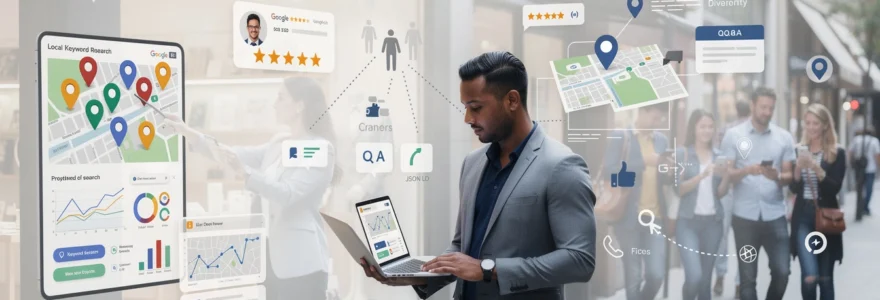
When potential customers search for services « near me » or within their immediate vicinity, the businesses that appear first capture the lion’s share of attention, foot traffic, and revenue. Local search has fundamentally transformed how consumers discover and engage with businesses in their communities. According to BrightLocal’s 2024 survey, 98 percent of consumers use the internet to find local businesses, with 76 percent examining a company’s online presence before making a physical visit. This shift represents both an unprecedented opportunity and a significant challenge for businesses competing for visibility in geographically targeted search results. The businesses that implement sophisticated local SEO tactics systematically outperform competitors, appearing prominently when customers are ready to make purchasing decisions.
Google business profile optimisation for hyperlocal visibility
Your Google Business Profile (GBP) functions as the digital cornerstone of your local search presence, directly influencing whether your business appears in the coveted local pack—the top three map-based results that dominate local searches. Research demonstrates that an actively managed GBP is essential for enhancing local search visibility and connecting with potential customers who are actively seeking your services. The profile serves as your first impression for countless prospective customers, displaying critical information including your business name, category, operating hours, location, imagery, reviews, and real-time updates. Optimising this profile comprehensively increases your probability of appearing in high-intent local searches exponentially.
Claiming and verifying your Google Business Profile represents the foundational step in this process. Navigate to the Google Business Profile platform and either create a new listing or claim an existing one that may have been automatically generated. Google will dispatch a verification code to your registered business address, which you must enter to confirm ownership. This verification process establishes your legitimacy and grants you administrative control over how your business information appears across Google Search and Google Maps. Without verification, you forfeit the ability to manage your profile, respond to reviews, or update critical business details—severely limiting your local search potential.
NAP consistency across digital citations and local directories
NAP consistency—ensuring your business Name, Address, and Phone number appear identically across all digital platforms—represents a fundamental ranking signal for local search algorithms. Search engines evaluate the consistency of your business information across hundreds of data sources to determine legitimacy and trustworthiness. Even minor discrepancies such as « Street » versus « St. » or variations in suite numbers can confuse search algorithms and dilute your local search authority. Conduct a comprehensive audit of your NAP information across your website footer, Google Business Profile, social media platforms, industry directories, and citation sources to identify and rectify inconsistencies systematically.
Building authoritative local citations involves listing your business on reputable directories including Yelp, Bing Places, Apple Maps, and industry-specific platforms relevant to your sector. For restaurants, citations on TripAdvisor and OpenTable carry significant weight; for home service providers, platforms like Houzz and Angie’s List matter considerably. Each citation serves as a validation point, signaling to search engines that your business operates at the specified location. Prioritise directories with high domain authority and genuine user engagement rather than spammy, low-quality listing sites that provide negligible value.
Leveraging google posts and Q&A features for enhanced engagement
Google Posts enable you to publish timely updates directly within your Business Profile, appearing prominently when users view your listing. These posts can highlight special offers, upcoming events, new products, or company announcements, providing dynamic content that signals active business management. Posts remain visible for seven days (or until the event date for event posts), making them ideal for promoting time-sensitive offers. Regular posting demonstrates to both Google’s algorithms and potential customers that your business maintains an active, engaged online presence—a factor that influences local search prominence.
The Questions and Answers section of your Google Business Profile frequently receives inquiries from prospective customers seeking specific information. Proactively populate this section by posting and answering common questions yourself, addressing frequent concerns about parking availability, accessibility features, payment methods, or service specifics. This preemptive approach reduces friction in the customer journey whilst incorporating relevant local keywords naturally. Monitor this section regularly to respond promptly to genuine customer inquiries, as response speed and thoroughness influence how potential customers perceive your business.
Strategic category selection and
attribute optimisation
Category selection within your Google Business Profile is not a trivial choice; it is one of the most powerful levers you have for signalling relevance to Google’s local algorithm. Your primary category should describe your core offering as specifically as possible—for example, « Emergency plumber » instead of simply « Plumber ». Secondary categories should support additional services you genuinely provide, such as « Water damage restoration » or « Boiler repair service ». Overloading your profile with loosely related categories can actually dilute relevance, so prioritise accuracy and alignment with the search terms your ideal customers use.
Attributes allow you to surface nuanced information about your business that directly influences click-through rates for « near me » searches. Options such as « Wheelchair accessible entrance », « Women-owned », « LGBTQ+ friendly », « Outdoor seating » or « 24-hour service » help your listing appear for highly specific local SEO queries and filter-based searches. Think of attributes as the digital equivalent of signage on your shopfront—each one provides an extra reason for nearby customers to choose you over competitors. Review your attributes quarterly, especially if you introduce new amenities, change hours, or expand your service offerings.
Review generation workflows and sentiment management strategies
Online reviews play a decisive role in local SEO performance, affecting not only your visibility in the local pack but also conversion rates once users find you. Google’s documentation explicitly notes that review quantity, recency, and overall rating influence local search prominence. To build a consistent flow of authentic reviews, develop standardised workflows that prompt customers at natural moments—immediately after a successful appointment, purchase, or completed project. Automating review requests via email or SMS reduces friction and ensures review acquisition is not dependent on sporadic manual efforts.
Effective sentiment management goes beyond accumulating five-star ratings; it involves active, thoughtful responses to both praise and criticism. Responding publicly to positive reviews reinforces your brand personality and encourages more customers to share their experiences. Addressing negative reviews calmly and constructively demonstrates professionalism and problem-solving ability, which can turn a potential liability into a trust signal. From a local SEO perspective, your responses also provide an opportunity to weave in localised terms (such as suburb names or service types) in a natural, non-spammy way, further reinforcing topical and geographic relevance.
Local keyword research and geographic targeting methodologies
Robust local keyword research underpins every successful « near me » SEO campaign, informing how you structure content, optimise your Google Business Profile, and design geo-targeted landing pages. Unlike broad national SEO, local keyword strategy must factor in proximity, micro-neighbourhood terminology, and the nuances of how people describe their area. A user might search for « dentist in SoHo » instead of « dentist in New York City », and your local SEO tactics must account for both variants. The objective is to map your services to the exact phrases locals use, then align on-page optimisation, citations, and business profile content around those terms.
Modern local SEO tools make it possible to analyse search demand at a granular geographic level, revealing where competition is fiercest and where hidden opportunities lie. By layering search volume data with real-world business intelligence—such as where your existing customers live or which suburbs generate the highest lifetime value—you can prioritise your efforts strategically. Done well, this process ensures you are not merely targeting high-volume terms, but the localised queries most likely to result in profitable leads and repeat customers.
Proximity-based search intent analysis using BrightLocal and whitespark
Tools such as BrightLocal and Whitespark enable you to simulate local search results from different postcodes, suburbs, or even specific map coordinates, giving you a clear picture of how proximity affects visibility. Google’s local algorithm weighs distance, relevance, and prominence; proximity data helps you understand how far your « local dominance » extends and where competitors begin to outrank you. For example, you might rank first for « coffee shop near me » within one kilometre of your address but drop out of the top three once users are three kilometres away. This insight reveals where additional local SEO tactics—like more citations or location-specific pages—are required.
Interpreting proximity-based intent is a little like reading a heat map for demand and competition. When you see certain districts where your rankings lag despite reasonable search volume, that signals an opportunity to tighten your targeting. Perhaps your Google Business Profile categories need refinement, or you require more location-specific content tailored to that suburb. By combining BrightLocal or Whitespark data with analytics from your website and Google Business Profile Insights, you can make informed, data-driven decisions instead of guessing which areas to prioritise.
Neighbourhood-level keyword mapping and suburb targeting
Neighbourhood-level keyword mapping involves assigning specific local keywords to individual pages, posts, and profile elements, ensuring you do not cannibalise your own rankings by targeting the same phrase across multiple URLs. For businesses serving broad metropolitan areas, this often means creating distinct content for suburbs, districts, or boroughs—think « plumber in Camden », « plumber in Islington », and « plumber in Hackney » rather than a single, generic « plumber in London » page. Each suburb-focused asset should reference local landmarks, transit routes, and colloquial place names that residents actually use.
This suburb targeting approach mirrors how offline word-of-mouth spreads—hyperlocal and community-based. When your digital assets speak the same geographic language as your audience, you increase both relevancy and trust. Search engines also benefit from this clarity, more easily associating your business with specific micro-areas. To prevent over-optimisation, focus on unique value for each neighbourhood page: highlight different projects, testimonials from local clients, or tailored offers for that area rather than simply swapping out suburb names in otherwise identical content.
Voice search optimisation for near me queries
Voice search has transformed how people express local intent, with users often posing natural-language questions like « Where is the closest tyre shop open now? » rather than typing short, fragmented keywords. To optimise for these voice-driven « near me » searches, structure your content to answer conversational queries directly and succinctly. FAQ sections, Q&A content on your Google Business Profile, and schema-backed question-answer blocks help search engines identify you as the best response to specific local queries.
Think of voice search optimisation as making your business easier to « recommend » by virtual assistants such as Google Assistant or Siri. These systems favour results that provide clear, concise answers and accurate, up-to-date business information. Include phrases that mimic spoken language (« Who offers same-day AC repair in [city]? ») while still providing comprehensive, authoritative answers. Ensuring your site is mobile-friendly and fast-loading further increases the likelihood that your content will be surfaced for voice-driven local searches.
Long-tail localised keywords and geo-modified search terms
Long-tail localised keywords—phrases of four or more words that include geographic modifiers—tend to signal high intent and lower competition. Examples include « 24-hour locksmith in downtown Chicago » or « kids-friendly dentist near Bondi Beach ». While these keywords generate fewer searches individually, their conversion rates are often significantly higher because they match specific, urgent needs. Building content and meta tags around these geo-modified terms allows you to capture ready-to-buy customers your competitors may be ignoring.
To uncover these long-tail opportunities, analyse your existing Google Search Console data and review the « searches used to find your business » section in Google Business Profile Insights. You will often find variations of your core terms combined with street names, neighbourhood labels, or landmark references. Incorporating these into page titles, headings, and on-page copy—without keyword stuffing—strengthens your geographic relevance. Over time, a portfolio of pages targeting a diverse range of long-tail queries functions like a finely tuned net, catching highly motivated local searchers that broader tactics might miss.
Structured data markup implementation for local search results
Structured data markup acts as a translation layer between your website and search engines, explicitly describing key elements such as your business type, location, services, and events. For local SEO, implementing schema.org markup in JSON-LD format helps Google and other search engines understand your business context with far greater precision. This, in turn, can unlock rich result enhancements including review stars, opening hours, price ranges, and event listings directly in the SERP. While structured data alone will not guarantee top rankings, it amplifies the impact of your existing local SEO tactics by making your relevance more machine-readable.
Think of structured data as labelled shelves in a library. Without labels, a librarian may eventually figure out where each book belongs, but with them, classification is fast and accurate. Similarly, schema markup provides clear labels that reduce ambiguity about what your content represents. This clarity is especially important for bricks-and-mortar businesses competing in dense urban markets, where many entities share similar names, categories, or addresses.
Schema.org LocalBusiness markup and JSON-LD configuration
The cornerstone of structured data for local businesses is the LocalBusiness schema (and its more specific subtypes such as Restaurant, MedicalClinic, or AutoRepair). Implemented in JSON-LD format within your page’s <script type="application/ld+json"> tags, this markup should include essential properties like @type, name, address, telephone, url, geo coordinates, openingHoursSpecification, and, where applicable, priceRange. Align your NAP details in schema exactly with those on your Google Business Profile and citation sources to reinforce consistency.
Configuration errors can prevent search engines from fully parsing your markup, so it is vital to validate your implementation using tools such as Google’s Rich Results Test and Schema.org’s own validators. Whenever you update your opening hours, move premises, or change phone numbers, remember that your structured data must be updated as well. Treat schema like a living asset rather than a one-time technical project—ongoing accuracy is key to sustaining strong local search signals.
Service area schema for multi-location enterprises
For multi-location and service-area businesses, communicating where you operate is as important as stating who you are. Schema.org offers properties such as serviceArea, areaServed, and hasMap that allow you to define postcodes, cities, or regions in which you provide services. If you run several branches, each location should ideally have its own dedicated landing page with unique LocalBusiness markup reflecting that specific address and contact information. This granular approach helps search engines connect individual locations to searches conducted near them, rather than treating your brand as a single generic entity.
Service-area schema is especially valuable for businesses that visit customers at their premises—plumbers, cleaners, HVAC technicians, and similar trades. By specifying your coverage area in structured data, you reduce the risk of ranking for irrelevant local queries outside your operational radius. In practice, you might define coverage using city names or postcode ranges, aligning this data with the information in your Google Business Profile’s service area settings for maximum coherence.
Event and product schema integration for enhanced SERP features
Beyond core business details, local companies can gain significant visibility boosts by marking up specific events and products. Event schema allows venues, community organisations, and retailers to showcase upcoming workshops, concerts, or promotions directly in search results with dates, locations, and ticket information. For example, a local brewery hosting tasting nights can use event markup to appear in specialised event carousels when users search for « beer events near me this weekend ».
Similarly, Product schema with properties like name, image, offers, and aggregateRating can highlight key items you want local customers to discover. When combined with accurate inventory data via local inventory feeds, this markup supports features like « See what’s in store » on Google. The result is a more compelling, information-rich presence that not only attracts clicks but also reduces uncertainty for users deciding whether to visit your location.
Local link building and community-based authority development
Local link building focuses on earning backlinks from regionally relevant websites—local news outlets, community organisations, chambers of commerce, schools, and neighbouring businesses. These links act as endorsements of your authority and embeddedness in the community, strengthening your prominence signal in Google’s local algorithm. Unlike purely national link building, quality often matters more than sheer volume; a handful of strong local citations and contextual links may outperform dozens of irrelevant backlinks from far-flung domains.
Developing community-based authority requires proactive outreach and genuine participation in local ecosystems. Consider sponsoring youth sports teams, collaborating on charity initiatives, or co-hosting educational events with complementary businesses. Each activity creates natural opportunities for press coverage, social media mentions, and website links. Think of these partnerships as the online equivalent of being a well-known, trusted neighbour—when your brand is visible and active in local life, search engines and customers alike are more inclined to view you as a default choice.
Location-specific landing pages and geo-targeted content architecture
Location-specific landing pages are dedicated pages tailored to a particular city, suburb, or district that you serve. Instead of relying on a single, generic « areas we cover » page, you give each key location its own optimised URL, content, and metadata. This granular architecture allows you to align page titles, H1 headings, and on-page copy with location-based keywords such as « roof repair in West Seattle » or « physiotherapy clinic in Richmond ». When crafted with unique, locally resonant information, these pages become powerful assets for capturing geo-targeted organic traffic.
Effective geo-targeted content architecture also considers how users navigate your site. A logical hierarchy—such as /locations/city/suburb—helps both visitors and search engines understand relationships between pages. Within each location landing page, incorporate testimonials from nearby customers, references to local landmarks, and service details specific to that area. Avoid the temptation to clone pages and simply swap place names; duplication can dilute relevance and risk thin-content issues. Instead, view each location page as a mini home page for that area, tuned to the needs and language of its residents.
Mobile-first indexing and click-to-call conversion optimisation
With the majority of local searches now conducted on mobile devices, Google’s mobile-first indexing means your mobile experience effectively is your primary website in the eyes of search engines. Slow load times, cluttered layouts, or hard-to-tap buttons can all undermine local SEO performance and cause would-be customers to abandon your site. Prioritise lightweight design, compressed images, and streamlined navigation, ensuring that key local elements—address, opening hours, directions, and phone number—are immediately visible without excessive scrolling.
Click-to-call optimisation is particularly critical for « near me » searches, where users often want to contact a business immediately rather than fill out a form. Make your phone number tappable using the tel: protocol and place clear call-to-action buttons such as « Call now » or « Tap to book » above the fold on mobile pages. For service-based businesses handling emergencies—locksmiths, plumbers, electricians—this simple change can dramatically increase conversion rates. By combining mobile-friendly design with frictionless click-to-call functionality, you bridge the gap between local search intent and real-world customer engagement.